In today’s professional landscape, effectively conveying one’s expertise and value is crucial for career advancement. Whether one is transitioning to a new field, beginning their professional journey, or seeking to further develop their expertise, a well-defined personal brand serves as a strategic asset. It enables professionals to attract relevant opportunities, establish credibility, and distinguish themselves in competitive environments.
A valid approach to personal branding is the Personal Branding Canvas, developed by Luigi Centenaro. This framework provides a clear and visual method for defining one’s identity, positioning, and value proposition. The effectiveness of this tool, however, depends on a thoughtful and systematic approach to its application. The following guide outlines how to utilise the Canvas methodically to build a compelling and authentic personal brand.
Getting Started: Essential Materials
Before engaging with the Canvas, it is important to have the appropriate materials available:
- A printed version of the Canvas (A1 or A2 size for better visibility)
- Sticky notes
- Markers or bold pens for clear and impactful writing
- Painter’s tape to attach the Canvas to a wall
Once the workspace is prepared, the process can begin step by step. Each idea should first be written on a sticky note before being placed on the Canvas—this approach allows for flexibility and refinements throughout the process. Ideas should be kept concise, using one to three words per note and listing them separately to maintain clarity.
To maximise effectiveness, it is recommended to begin from the right side of the Canvas and proceed systematically through each section.
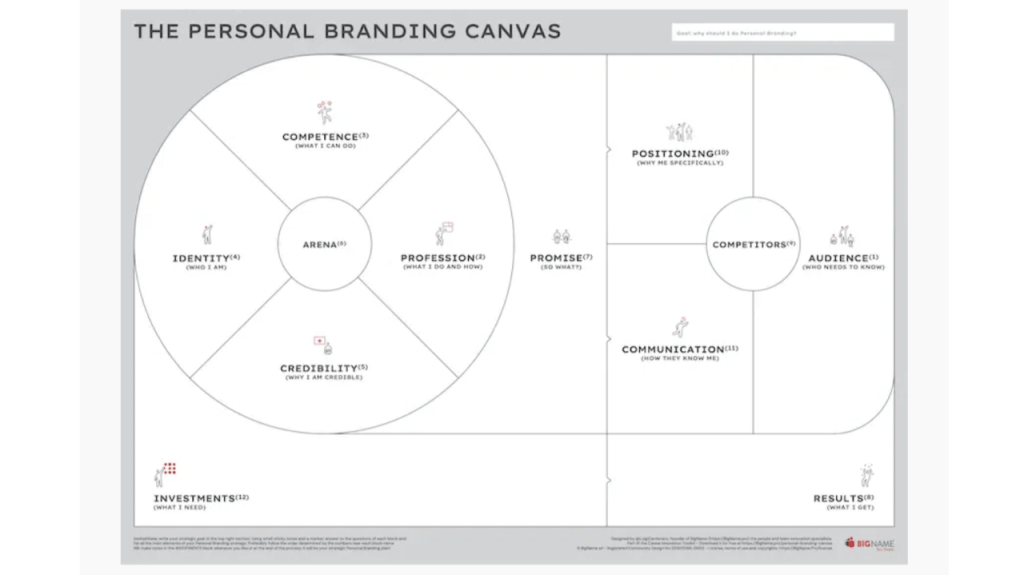
1. Audience – Who Needs to Know You?
A personal brand is only as strong as its relevance to the intended audience. Identifying key stakeholders—such as hiring managers, recruiters, executives, industry peers, or potential clients—is the first step in crafting an impactful brand. Understanding their expectations and challenges ensures a targeted and strategic approach.
2. Arena – Where Do You Operate?
The arena represents the broader environment in which you as a professional operate. This includes the industry, prevailing market trends, and specific contexts shaping career opportunities. Defining this landscape helps ensure that branding efforts are aligned with industry expectations and professional objectives.
E.g.: Fintech, supply chain, healthcare consulting.
3. Competence – What Can You Do?
Competencies encompass both technical expertise and interpersonal skills that contribute to professional effectiveness. Clearly outlining these capabilities—including leadership qualities, specialised knowledge, and problem-solving skills—ensures that the personal brand is built upon a solid foundation of demonstrated abilities.
E.g.: Data analysis, strategic planning, negotiation.
4. Identity – Who Are You?
A strong personal brand is rooted in authenticity. Defining core values, motivations, and distinguishing personal attributes ensures alignment between professional branding efforts and personal aspirations. A well-defined identity fosters consistency and trustworthiness.
E.g.: Innovative, results-driven, collaborative.
5. Profession – What Do You Do and How?
A personal brand gains clarity when the professional role is well articulated. This section focuses on specialisation, methodologies, and approach to work, ensuring that positioning within the industry is both clear and compelling.
E.g.: HR consultant, agile coach, digital marketer.
6. Credibility – Why Should They Trust You?
Establishing credibility is fundamental to building trust. This includes certifications, professional experience, client testimonials, case studies, and industry recognitions that substantiate expertise. A brand built on a solid track record strengthens its impact.
E.g.: PMP certification, 10+ years in finance, published research.
7. Promise – What Value Do You Offer?
A strong personal brand must articulate a clear and compelling value proposition. Defining the problems addressed, the impact created, and the reasons stakeholders should place trust in the professional’s expertise ensures that the brand remains relevant and sought after.
E.g.: Efficiency improvement, talent retention, revenue growth.
8. Investments – What Do You Need?
Effective personal branding requires strategic investments, whether in continuous professional development, networking, or marketing resources. Identifying necessary resources ensures a sustainable and evolving brand strategy.
E.g.: Online courses, mentorship, speaking engagements.
9. Results – How Do You Measure Success?
Assessing the impact of branding efforts is essential. Key indicators include increased visibility, new career opportunities, professional connections, and overall return on investment in branding activities. Measuring progress helps refine the approach over time.
E.g.: LinkedIn engagement, job offers, media mentions.
10. Competitors – Who Else is in Your Space?
Recognising competitors provides valuable insights into differentiation. Understanding how others in the industry position themselves helps refine unique value propositions and enhances competitive advantage.
E.g.: Other HR consultants, digital strategists, leadership coaches.
11. Positioning – Why You Specifically?
Positioning determines how a professional is perceived within their industry. Clearly defining unique strengths and distinguishing factors ensures a compelling and differentiated brand presence. A strong positioning strategy enhances credibility and attractiveness.
E.g.: AI-driven HR solutions, people-first leadership, customer-centric approach.
12. Communication – How Do They Know You?
Visibility is crucial for an effective personal brand. Identifying the appropriate communication channels ensures that expertise is consistently shared and reinforced within the industry.
E.g.: Webinars, blog posts, networking events.
Final Thoughts: Take Action
The Personal Branding Canvas is a powerful tool that allows professionals to take control of their career narrative. However, its true value lies in practical implementation. A strong personal brand is not built solely through reflection but through continuous refinement and strategic action.
Download the Canvas at https://bigname.pro/personal-branding-canvas, print it, and start structuring your personal brand today.

 Beyond grey matter
Leave a comment